As a researcher in the Summer Undergraduate Research Institute in Experimental Mathematics Research Experience for Undergraduates, I worked with Professor
Olga Turanova and Professor
Christian Parkinson to study the porous medium equation with reaction from both an analytical and numerical perspective. The
porous medium equation is a non-linear version of the
heat equation, defined as, for \(m>1\), \[
u_t-\Delta(u^m)=0.
\]
It is of interest in cases of non-linear diffusion, like bacteria and tissue growth, gas flow, and non-linear heat transfer. For our purposes, we think about the equation as modeling the growth of a tumor. For this reason, the equation we study has a reaction term, with a similar intuition as for the
logistic growth or
Fisher-KPP equation. For a function \(\mu:\mathbb R\to\mathbb R \), a constant \(m>1\), and \(p(x,t):=\frac{m}{m-1}u(x,t)^{m-1}\), this equation in one spatial dimension is \[
u_t-(u^m)_{xx}=u(\mu(x)-p).
\]
Here, \(\mu(x)\) can be thought of as the favorability of the environment in which the tumor lives, with negative values corresponding to unfavorable locations, and positive values to favorable ones.
In the \(m\to\infty\) limit, under certain assumptions, we obtain the system of ordinary differential equations (ODEs), with \(\overline{p}=\displaystyle\lim_{m\to\infty}p\) \[
\begin{cases}
-\overline{p}_{xx}=\mu(x)-\overline{p}\qquad\text{on }(r_1(t),r_2(t)),\\
\dot r_i(t)=-\overline{p}_x(r_i(t),t),\\
r_i(0)=a_i,\qquad a_2>a_1,\\
\overline{p}(r_i(t),t)=0.
\end{cases}
\]
For the modified system where we fix the left boundary \(r_1(t)=0\) and declare \(\overline{p}(0,t)=1\), we proved various results about the existence and uniqueness of solutions (under certain assumptions on \(\mu\)), and a non-decreasing result for the solutions \(r_2\). More importantly, we proved that, given a \(\mu\) with \(\mu(x)\geq0\) almost everywhere on \([0,a_2]\), then \(\overline{p}(x,t)\geq0\) on \((0,r_2(t))\) for all \(t\). In addition to other theoretical results about the system of ODEs and the original partial differential equation (PDE), we modeled both numerically with various choices of \(\mu\) using explicit and implicit schemes for the
finite difference method. From our observations, we developed conjectures about the behavior of the ODE and PDE systems under different initial conditions.
As an undergraduate research assistant to Professor
Demetre Kazaras, our research together lies at the intersection of functional analysis and differential geometry, focusing on variational problems arising in the theory of elasticity. We use tools from the calculus of variations and differential equations to study the bending energy of curves under geometric constraints, seeking energy-minimizing configurations of thin elastic rods. The study of such elastic materials is known as the problem of
Euler's Elastica. The question was initially posed to Euler by Daniel Bernoulli in 1742, asking what the energy minimizing configuration of a perfectly elastic wire is under certain
clamping conditions, that is, a fixed start and end point and start and end direction vector for the wire. In particular, the search is for planar curves \(\gamma\) satisfying the clamping conditions that minimize the
bending energy, \[
B[\gamma]=\int_\gamma\kappa^2(s)\ \mathrm ds,
\] where \(s\) is the arc-length parameter and \(\kappa\) the
curvature of \(\gamma\). From the method of
Lagrange multipliers, one finds that for a critical point \(\gamma\) of \(B\), there is a \(\lambda\in\mathbb R\) such that \(\gamma\) is a critical point of \[
\int_\gamma\kappa^2(s)\ \mathrm ds+\lambda\int_\gamma\mathrm ds=B[\gamma]+\lambda\operatorname{len}(\gamma).
\]
After calculating the first variation, we find that the curvature satisfies the "elastica equation", \[
2\partial_s^2\kappa+\kappa^3-\lambda\kappa=0,
\] solutions to which are referred to as "Euler's elastica" or, more commonly, "elastica". In their
2025 paper,
Tatsuya Miura and
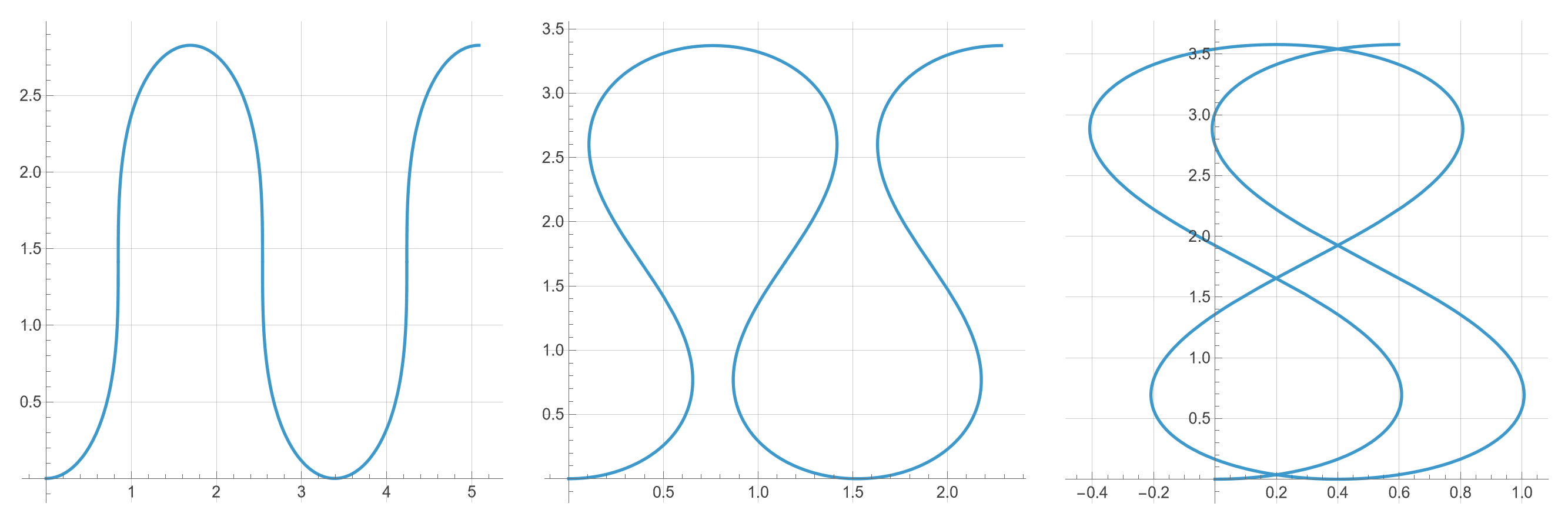
Glen Wheeler gave explicit parameterizations of all elastica, classifying them into 5 distinct groups: the linear and circular elastica, with the expected parameterizations, along with the wavelike, borderline, and orbitlike elastica. In our research, we worked to show the existence of a subclass of the wavelike elastica, which we call "up-down elastica", while also computing their bending energies and making some conjectures about their bending energies in relation to other solutions with the same boundary conditions. From the parameterizations provided in Miura and Wheeler's paper, we can obtain plots of elastica like below.
Upon rotation and scaling, we can find a "different-looking" wavelike elastica that solves a different problem on the interval \([0,1]\) with \(e_1\) tangent vectors.
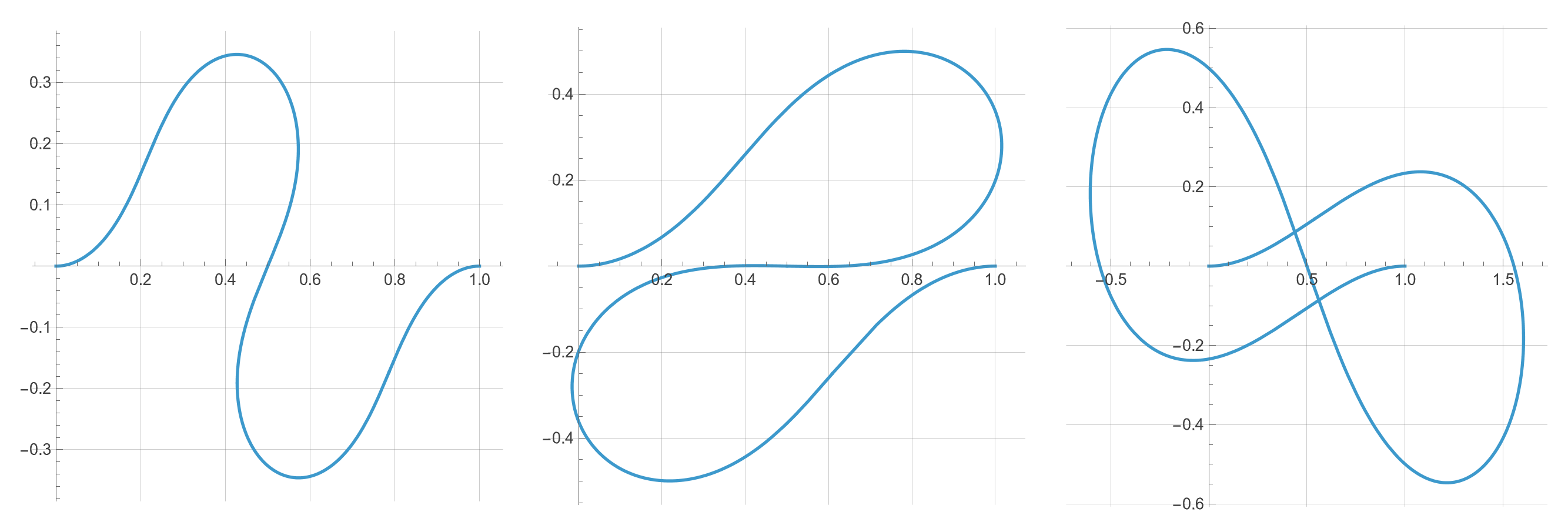
Our work is in proving the existence and describing this subclass of the wavelike elastica.